About / WEK CONSTRUCTION
A technology practice shaped by construction
WEK CONSTRUCTION exists to close the distance between how construction projects are delivered and how the software supporting them behaves. We design, build and maintain digital systems for construction organisations and the disciplines around them.
What the company is
WEK CONSTRUCTION is an information technology company specialising in digital solutions for construction companies. The work spans custom software, management platforms, web and mobile applications, workflow automation, cloud infrastructure, integration, analytics and interface design.
Rather than adapting general business tools to a construction context, the company starts from the constraints of the sector: staged delivery, contractual accountability, distributed teams, changing scope and information that has to remain defensible long after handover.
Engagements range from a single focused application replacing a fragile spreadsheet process, to a connected platform that becomes the record of a project from tender through to operation.
02 / Mission
Make project information trustworthy and usable
Our mission is to give construction teams systems where information is entered once, remains accurate, and is available to the people who need it at the moment a decision is made. We aim to remove duplicated administration, reduce avoidable rework, and make the true state of a project visible without a manual reporting exercise.
03 / Vision
Digital tools as ordinary site equipment
We work towards a construction sector where digital tools are as unremarkable and dependable as a level or a laser: used without hesitation, trusted without supervision, and continuous from the first estimate to long-term operation of the finished asset.
How we operate
Understand before proposing
No solution is described until the existing process, its exceptions and its informal workarounds are understood in detail.
Design for the least favourable conditions
If a tool works in rain, in poor signal and under time pressure, it will work everywhere else.
Write things down
Decisions, data models and architecture are documented so knowledge stays with the organisation.
Prefer small releases
Frequent, reversible changes reveal problems early and keep systems adaptable.
Say what is uncertain
Unknowns and trade-offs are raised while they can still influence the plan.
Build for the next maintainer
Clarity in code and structure is treated as a deliverable, not an internal preference.
Our approach to change
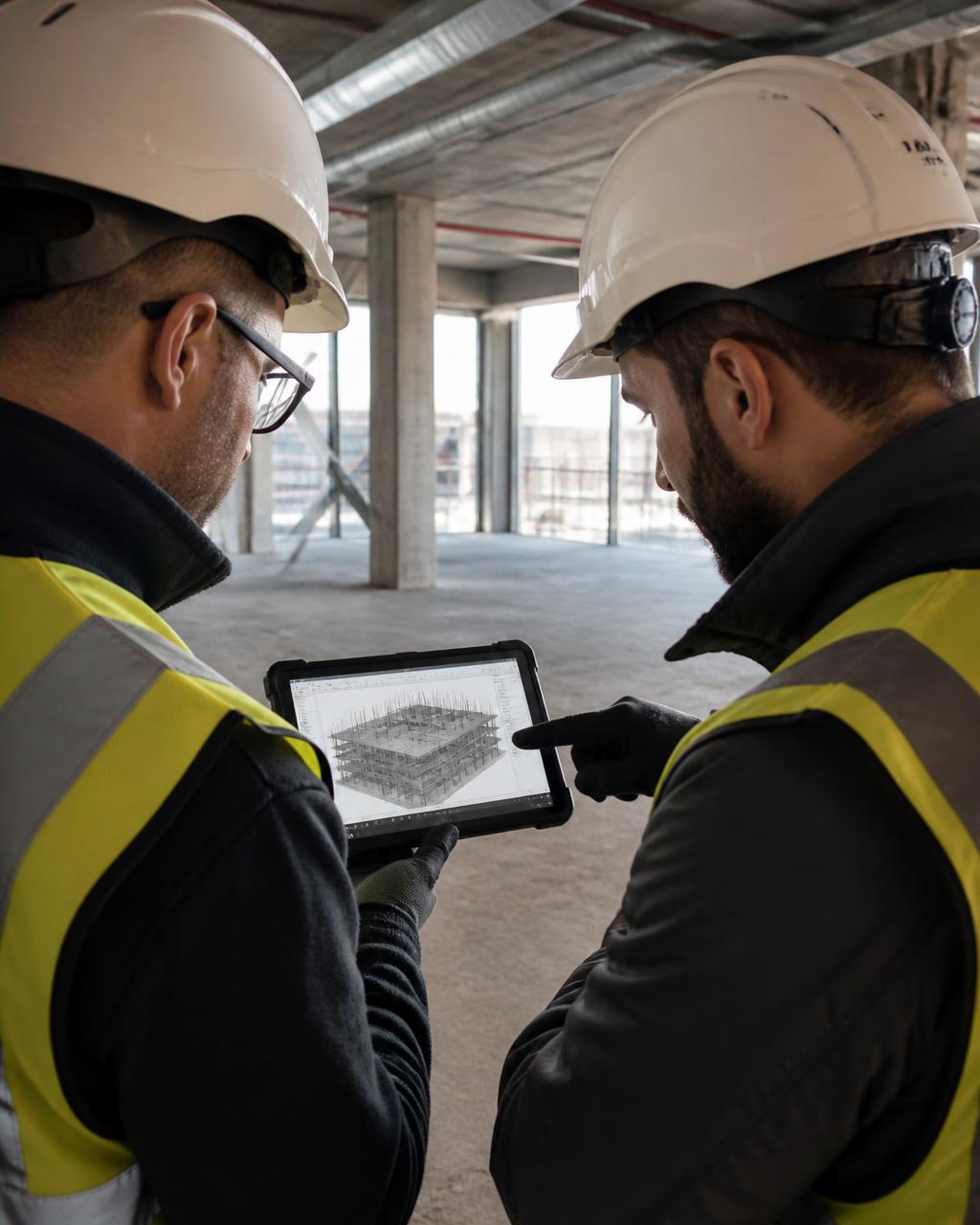
Digital transformation fails most often when it is treated as a purchase rather than a change of practice. We approach it in stages: stabilise the information that already exists, remove the most expensive manual steps, then extend into planning, analysis and automation once the foundation is reliable.
Adoption is part of the engineering problem. A system introduced without training material, without a fallback, or without the people who will use it having shaped it, is unlikely to survive its first difficult week on site.
Existing tools are respected. Where a package already performs well, it is integrated rather than displaced, and the transformation is measured by how much friction disappears rather than by how many products are replaced.
What quality means here
Quality is judged by behaviour under load, not by appearance in a demonstration. A system is good when it holds up during a busy week, recovers cleanly from failure, and produces the same answer twice.
Practically this means automated testing around critical logic, code review as routine, explicit error handling, monitoring in production, and performance treated as a requirement rather than an optimisation to consider later.
Accessibility and clarity belong to quality as well. Information that cannot be read quickly, or on the device actually in someone's hand, has not been delivered.
Working together
Work is organised in short cycles with visible output. Each cycle ends with something that can be examined and questioned by the people who will depend on it, which keeps direction correctable and expectations aligned.
Communication is plain and direct. Progress, blockers and changes in estimate are reported as they occur rather than gathered into an end-of-phase surprise.
Client teams remain owners of the process being digitised. Our role is to translate that process into a system that is dependable, and then to keep it that way.
An engineering-led company
Craft over novelty
Technology choices are made for suitability and longevity, not for how recently they appeared. Boring, well-understood components carry critical paths.
Continuous learning
Tools, standards and construction practice all move. Time is deliberately spent studying both sides of that boundary.
Shared ownership
Systems are built to be understood by more than one person, with review, documentation and consistent structure as standing habits.
09 / Closing statement
Construction builds what lasts. Its software should be built the same way.
WEK CONSTRUCTION applies engineering discipline to the digital side of the industry — deliberate, documented, maintainable, and made for the conditions the work actually happens in.
loisperez19973@gmail.com